

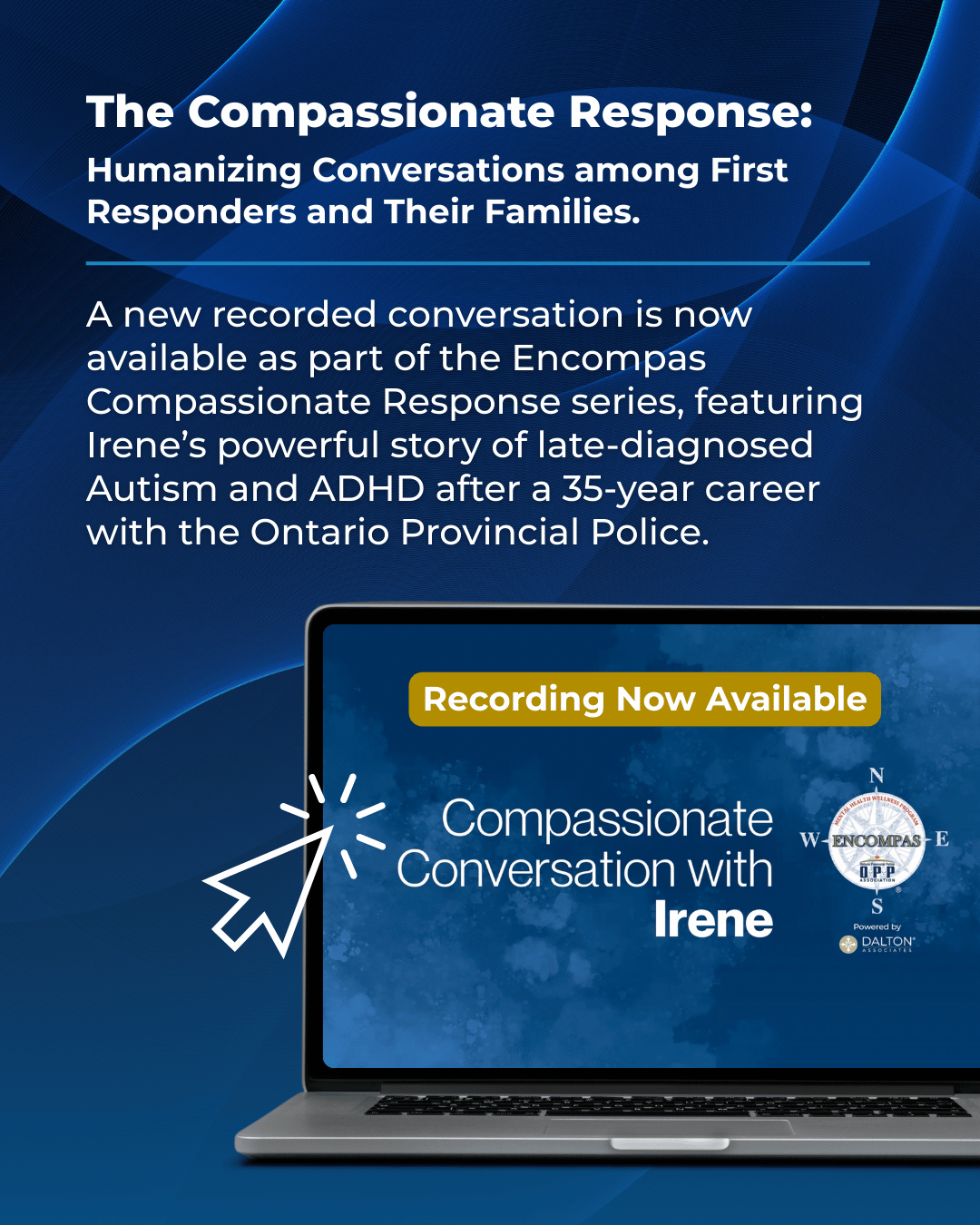
The Compassionate Response:
Humanizing Conversations Among First Responders and Their Families
Living Undiagnosed: Irene’s Story of Autism, ADHD, and Autistic Burnout in the OPP
Recorded Session Now Available
A new recorded conversation is now available as part of the Encompas Compassionate Response series, featuring Irene’s powerful story of discovering late-diagnosed Autism and ADHD after a 35-year career with the Ontario Provincial Police.
After retiring in 2019, Irene entered an unexpected period of exhaustion, social withdrawal, and emotional collapse, which she later learned was autistic burnout. In this session, she reflects on navigating neurodivergence within a regimented workplace, the toll of masking, and the relief that came with finally understanding her own experience.
This recording shines a light on late diagnosis, workplace barriers, and the unseen challenges many first responders and civilian members face when their needs go unrecognized.
About This Recorded Conversation – Shared by Irene:
I consider myself fortunate and am grateful to have had a 35-year career with the Ontario Provincial Police as a Civilian Member. Never could I imagine a more fulfilling and rewarding line of work than being of service to the citizens of Ontario. As fulfilling as the job was, I struggled throughout the years with interpersonal dynamics in the workplace and often found navigating new environments and processes challenging.
I retired in 2019 and went through a very rough couple of years. Transitional challenges are not unusual for retirees, but what I experienced was beyond adjusting to different routines or focusing on new objectives. Eventually, I began to emerge from the unrelenting fatigue and social isolation. I started slowly with solo activities like reading. More and more, I was drawn to articles and information regarding neurodiversity. Pieces of a lifelong puzzle began falling into place, and I realized that I might benefit from undergoing an assessment for Autism and/or ADHD. In November of 2024, I was assessed and diagnosed with Autism Spectrum Disorder Level 1 (Requiring some support in the areas of Social Communication and Restricted Interests/Repetitive Behaviour) and Attention Deficit Hyperactivity Disorder: Combined Type. I realized then that what I experienced when I retired was autistic burnout. I had spent a lifetime managing an undiagnosed condition and could no longer keep it up.
I finally had an answer to the questions I had been asking myself for decades. Why do I find everything so complicated? Why can’t I maintain a friendship? Why doesn’t eye contact come naturally to me? Why do I have to do things in a certain way, or does it just not feel right? Why do I struggle with “ice breakers”? Why do people take me the wrong way? Why do I fidget? Revelations about longstanding behaviours, i.e., masking and stimming, began to sink in.
Unfortunately, due to difficulties navigating social interactions, interpreting others’ intentions, ineffective communication styles, etc., individuals with ASD/ADHD are inordinately susceptible to bullying and harassment. They are also at an increased risk of developing PTSD. This neurotype can also sometimes hinder career advancement, especially in a regimented organization such as the OPP. Conformity and protocol adherence are expected to maintain efficient operations effectively. Additionally, people on the autism spectrum frequently have sensory issues such as sensitivity to light, noise, and scents, which are among the most common. Accommodations for special needs can, in some cases, be challenging to obtain. I was personally impacted by all of these issues during my career.
The fact that I was unaware I had ASD/ADHD resulted in years of struggle and not understanding why. My requests for support went unmet because neither I nor my supervisors understood why I needed it. ASD and ADHD are recognized as disabilities in Ontario under the Ontario Human Rights Code and Canadian human rights legislation, and are chronically under diagnosed in females. Therefore, you are entitled to workplace accommodations if you are diagnosed with one or both disorders. That is why I am sharing this intensely personal information with you; I’m hoping to assist others in avoiding a similar experience. I sincerely hope that if my story resonates with anyone, they will delve deeper into questions they may have asked themselves throughout their lifetime.
The assessment I took was conducted remotely and was entirely covered by our health benefits. In-person assessments are also available. Getting a predetermination from Canada Life before doing an assessment is best.